When using Einstein Recommendation Builder, it’s helpful to understand some terms we use for sets of data.
Objects That Form a Recommendation
Einstein recommendations are based on three types of Salesforce objects:
- The Recommended Items object contains the records that you want to recommend. For example, you can recommend financial products, which are stored on the Product object.
- The Interactions object is where Einstein finds stored interactions between the Recommended Items and Recipient objects. When an account purchases a product, the interaction is stored on the Order History object.
- The Recipient object contains the records that receive the recommendation. Maybe you’re
recommending financial products to small businesses, which are stored on the Account
object.
To learn more about objects, see Object Type Examples.

Segment
A segment is a subset of your dataset.
Since Einstein draws its patterns from your data, select records that are relevant to your use case by defining segments.
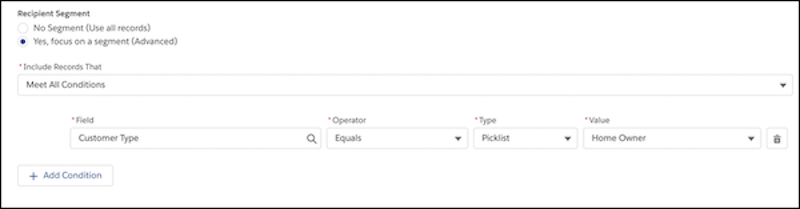
After selecting an object, you can focus your recommendation on a segment of your data. Use condition logic to filter your dataset, which creates a subset of that data. For example, if your recommended items are bank products, you can focus on credit cards. If your recipient object is contact, you can focus on current customers who are home owners.
Positive and Negative Interactions
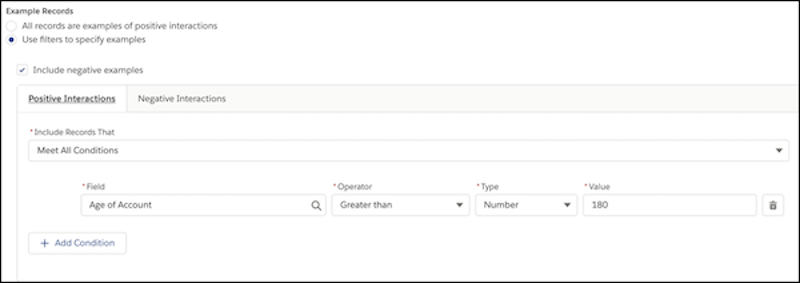
Positive interactions are records in your dataset that serve as examples of relevant past successful outcomes between the recipient and recommended items. Einstein learns from these examples to make smarter recommendations over time. A positive interactions example is recommending Bank Products to Contacts using Date Created = Earlier than or equals a date at least 6 months earlier.
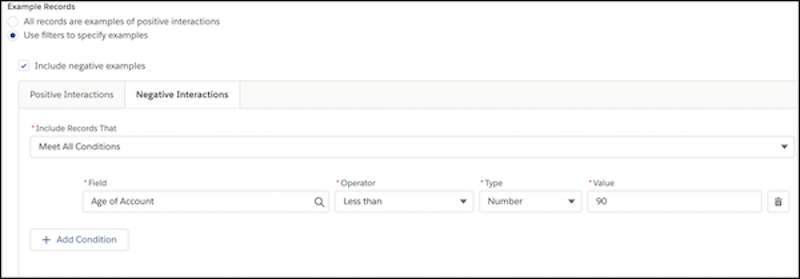
Similarly, negative interactions are records in your dataset that represent undesirable business outcomes such as when a customer cancels within 90 days to take advantage of or a promotion. Negative interactions examples are optional, and can improve the recommendation quality when they’re available.