
The Energy & Utilities Sales data model includes objects and fields that publishers can use to store and manage information about their reference products, tariff comparison, opportunities, quotes, and orders that sales reps use to engage prospective and existing customers. The data model is built with industry-wide best practices, and you can adapt and extend the data model to meet your company’s unique needs.
Energy Sales
Use these objects as a reference to build your Salesforce solution for Sales.
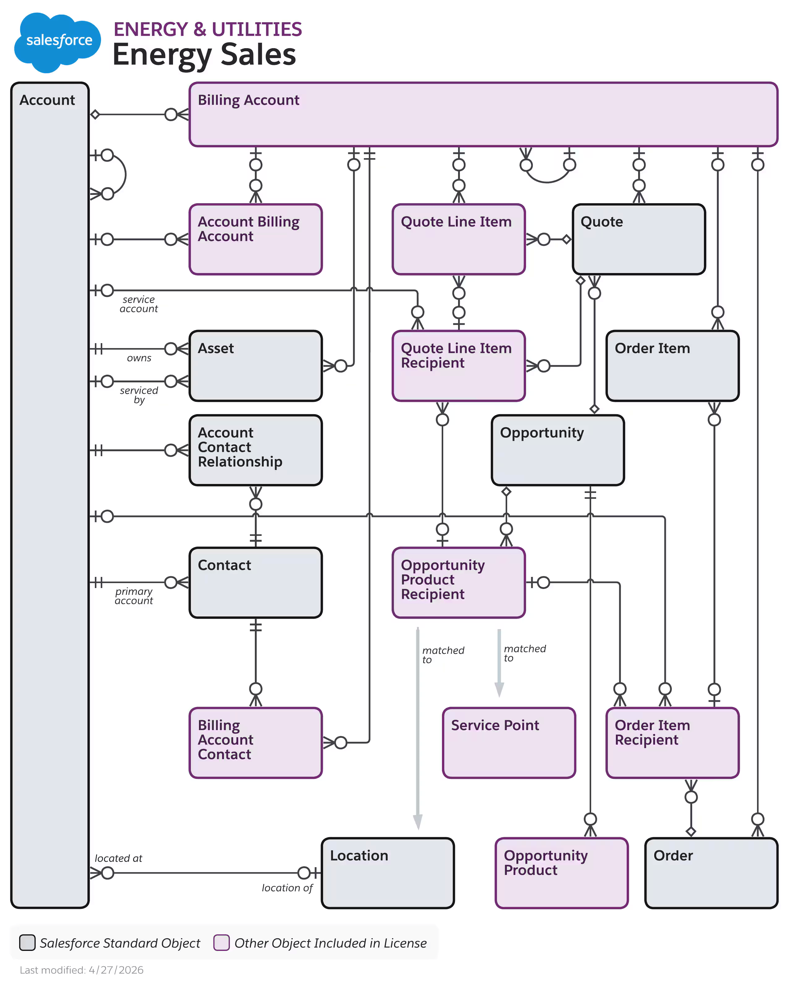
- Account
- Represents an individual account, which is an organization or person involved with your business (such as customers, competitors, and partners).
- Billing Account
- Represents the customer's billing controls in the backend system. Used to set up and maintain details such as bill frequency, bill format, and autopay details.
- Account Billing Account
- Represents a junction between Account objects and Billing Account objects.
- Asset
- Represents an item of commercial value, such as a product sold by your company or a competitor, that a customer has purchased.
- Account Contact Relationship
- Represents a relationship between a contact and one or more accounts.
- Contact
- Represents a contact, which is a person associated with an account.
- Billing Account Contact
- Represents a junction between Billing Account objects and Contact objects.
- Quote Line Item
- Represents a quote line item, which is a member of the list of Product2 products associated with a quote, along with other information about those line items on that quote.
- Quote Line Item Recipient
- Represents a site, employee, or other entity for which services are being quoted. This could include details such as the recipient's name, contact information, associated site or location, and any specific requirements or preferences for the quoted services.
- Quote
- Represents a quote, which is a record showing proposed prices for products and services.
- Order Item
- Represents an order product that your organization sells.
- Opportunity
- Represents an opportunity, which is a sale or pending deal.
- Opportunity Product Recipient
- Represents a site that receives services or utilities related to an opportunity. The opportunity can be configured by one or more service points.
- Service Point
- Represents an entry point for services to a premises. The service provided to each service point is separately metered (or measured). Useful for energy services including electricity, water and gas services.
- Order Item Recipient
- Represents a site, employee, or other entity for which services are being ordered. This includes essential details such as the recipient's name, contact information, and the specific site or location where the services will be provided.
- Opportunity Product
- Represents the fields that contain information to help you track what’s selling.
- Order
- Represents an order associated with a contract or an account.
- Location
- Represents a warehouse, service vehicle, work site, or other element of the region where your team performs field service work.