
Measures emotional tone across customer conversations, text, and feedback to reveal underlying attitudes and opinions. It unifies textual and vocal sentiment across all interactions across marketing, sales calls, field notes, and billing to surface emotional drivers of loyalty or risk for proactive resolution and customer experience improvement.
Required Editions
| View supported editions |
SENT Use Cases
- To detect early warning signals of dissatisfaction or emotional disconnect before a customer submits a formal complaint or bad survey.
- To identify coaching opportunities for service or sales teams by analyzing the emotional tone of their interactions.
- To monitor the impact of marketing campaigns by tracking spikes in positive or negative sentiment across public channels and direct responses.
SENT KPIs
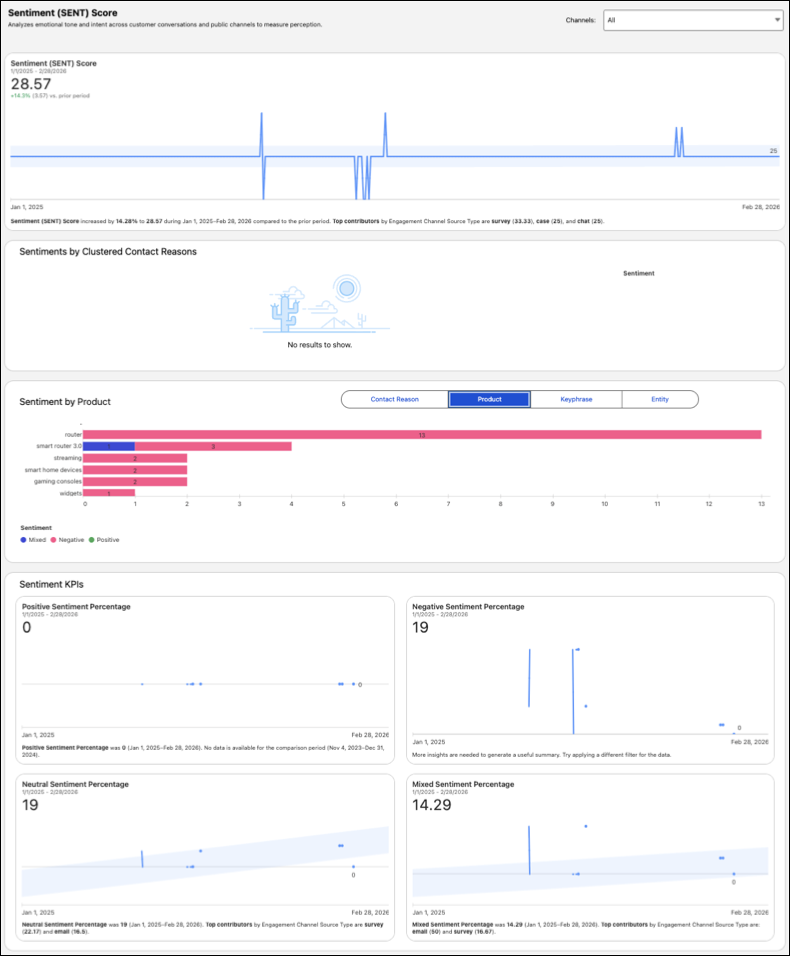
| KPIs | KPI Purpose |
|---|---|
| Sentiments by Clustered Contact Reasons |
Identifies systemic emotional trends by grouping related topics such as billing or onboarding into broader clusters. It helps leaders spot high-level friction points that require broad process improvements rather than just fixing isolated incidents. |
|
Sentiment by
|
Offers granular diagnostics by isolating the emotional tone attached to specific products, named entities, or exact contact reasons. It allows product and service teams to pinpoint exactly what feature or policy is driving joy or frustration, enabling precise fixes. |
| Positive Sentiment Percentage |
Tracks the volume of favorable interactions, serving as a direct indicator of brand advocacy and successful customer experiences. A rising trend here validates that improvements in product or service delivery are emotionally resonating with the customer base. |
| Negative Sentiment Percentage |
Acts as an early warning system for churn by quantifying the volume of friction and dissatisfaction in customer communications. Spikes in this metric trigger immediate alerts, allowing teams to intervene with at-risk accounts before frustration turns into attrition. |
| Neutral Sentiment Percentage |
Measures the baseline of transactional interactions where customers are not delighted or distressed, often representing routine operations. Tracking this helps identify opportunities to upgrade standard service transactions into memorable, positive experiences. |
| Mixed Sentiment Percentage | Identifies complex interactions where customers express both satisfaction and frustration simultaneously, such as loving a product but hating the delivery. It highlights areas where partial success is being undermined by specific friction points, guiding nuanced process tuning. |
| Account Watchlist |
Surfaces accounts exhibiting high levels of negative emotional tone in unstructured communications such as emails, calls, tickets. It serves as an early warning system, flagging customers who are emotionally distressed or frustrated even if they haven't submitted formal negative feedback. |
