
Quantifies the depth and frequency of customer interactions with products, services, and channels. It measures interaction depth across touchpoints such as digital, human, and transactional to drive adoption, stickiness, and upsell by signaling the true level of customer commitment.
Required Editions
| View supported editions |
EES Use Cases
- To identify specific stages in the sales cycle where prospects are stalling or dropping off.
- To measure the fluidity of handoffs between marketing and sales.
- To pinpoint service inefficiencies that are negatively impacting renewal rates.
EES KPIs
| KPIs | KPI Purpose |
|---|---|
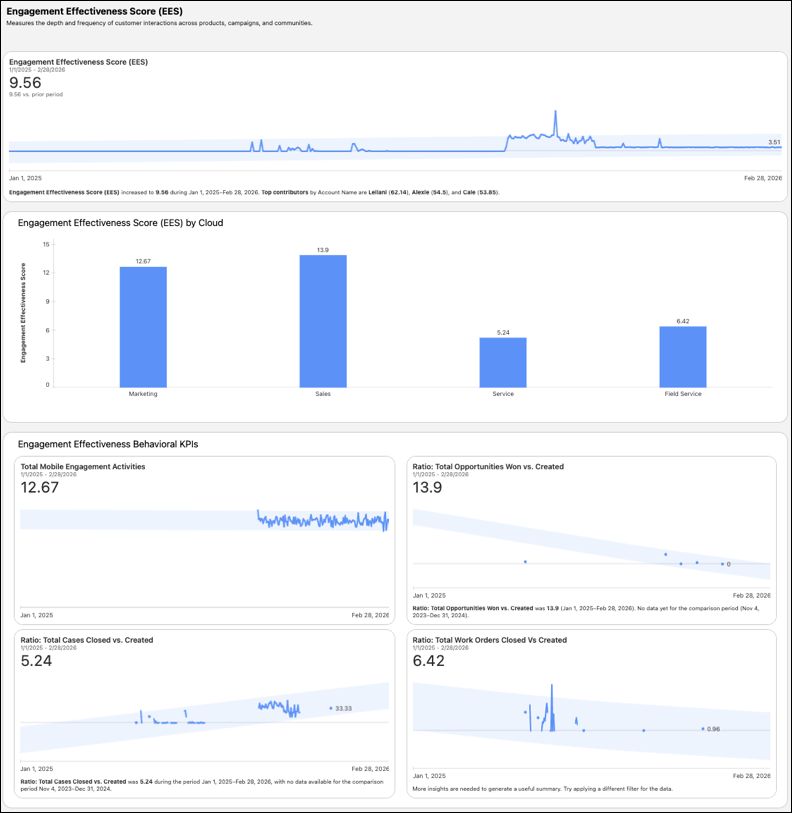
| Engagement Effectiveness Score (ESS) by Cloud |
Isolates engagement performance by department to reveal exactly which channels or teams are driving customer stickiness. It allows leaders to see if engagement is robust in sales but lagging in service, enabling targeted strategies to boost participation across the customer journey. |
| Total Mobile Engagement Activities |
Tracks the volume of digital interactions across channels like SMS and WhatsApp to validate active customer participation. High activity levels signal strong adoption and stickiness, confirming that customers are engaged and finding value in communication channels. |
| Ratio: Total Opportunities Won vs. Created |
Evaluates the quality of sales engagement by measuring how effectively new opportunities convert into closed-won deals. A high ratio indicates strong product-market fit and effective sales cycles, while a low ratio highlights potential issues in qualification or closing ability. |
| Ratio: Total Quotes Closed vs. Created |
Tracks the velocity of the commercial process to determine if pricing discussions are successfully translating into finalized business. It identifies friction points in the negotiation phase, making sure that customer interest isn’t being lost during the quoting stage. |
| Ratio: Total Cases Closed vs. Created |
Measures the service organization's capacity to resolve incoming issues at the rate they’re reported, serving as a key indicator of support health. A balanced ratio makes sure that backlogs aren't growing, which protects customer trust and prevents dissatisfaction. |
| Ratio: Total Work Orders Closed Vs Created |
Assesses field service execution by comparing the rate of completed jobs against the volume of new requests. It makes sure that operational delivery aligns with customer demand, preventing service delays that could erode engagement. |
| Account Watchlist |
Pinpoints accounts with declining interaction frequency across digital and human channels. It highlights customers who are becoming passive, indicating a risk to adoption and stickiness. |