
When you use the OAuth 2.0 hybrid app token flow, you use scopes to request session IDs (SID) and domain values. You then use these SIDs and domain values to set browser cookies and establish sessions in your hybrid app. When you refresh your access token, you receive new SIDs and domains to reset the browser cookies.
Required Editions
| Available in: both Salesforce Classic and Lightning Experience |
| Available in: All Editions |
Salesforce supports cookies that let you establish sessions with these domains.
- Primary Salesforce app via the
webscope - Content resources via the
contentscope - Lightning apps via the
lightningscope - Visualforce pages via the
visualforcescope
The web scope is a prerequisite to use the hybrid app flow—at minimum, your
hybrid app must be able to access your primary Salesforce domain. To access content resources,
Lightning apps, and Visualforce domains, assign their associated scopes in addition to the
web scope. For example, to access Lightning domains, assign your external
client app or connected app the web and lightning
scopes.
In all scenarios, you receive the sidCookieName, cookie-sid_Client, and cookie-ClientSrc values. These values are tied to the web scope.
When you use the hybrid app refresh token flow, you receive new return values that you use to reset the session cookies.
This table summarizes the return parameters you receive for each scope.
| Scope | Return Parameters |
|---|---|
web
|
|
content
|
|
lightning
|
|
visualforce
|
|
Hybrid App Flow Cookie Examples
These examples illustrate the browser cookies that are set when you use the web, content, lightning, and visualforce scopes.
When you assign the web scope to request a web session
in the Salesforce org’s primary domain, these cookies are set in the browser. 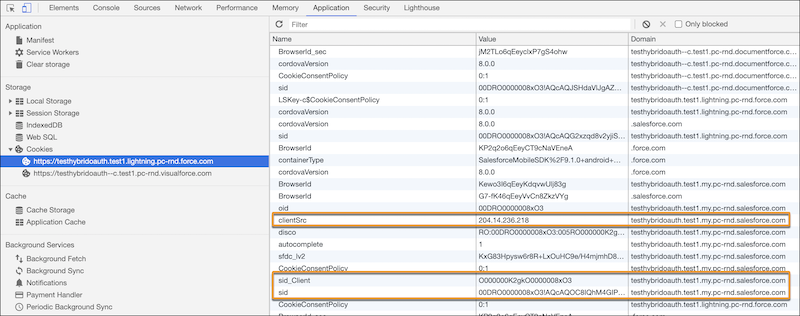

web scope is a prerequisite for the
content, lightning, and visualforce scopes, the
cookies in this example are set every time you use the hybrid app flow.
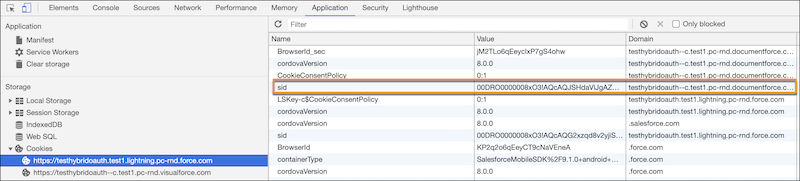
When you assign the content scope, this cookie is
set.
Assigning the lightning scope sets this cookie.
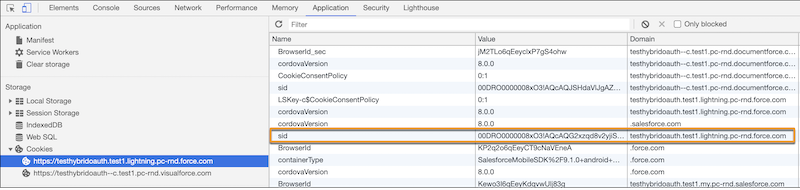
And when you assign the visualforce scope, this cookie
is set.
