
When you create a version of an object, commercial product, or picklist, the related entities for each are either automatically cloned or reused across the versions.
Version Relationship Types
Products have one of three types of relationships with EPC entities.
-
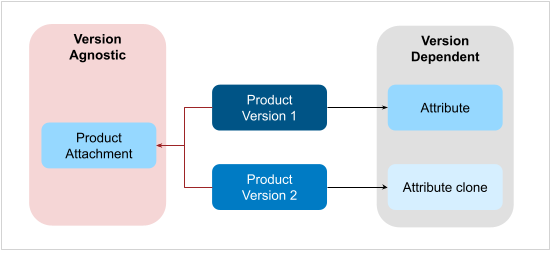
Version agnostic (Floating) — The record isn't cloned when you create a version. The same record is used for different versions of the same product. For example, if you modify a Product Configuration Procedure, those changes are reflected in all versions of the product that refers to that record.
-
Version dependent (Fixed) — The record is cloned and related to each corresponding version of the product.
The following diagram shows examples of version-dependent and version-agnostic relationships. Versions 1 and 2 of a product are related to the same Product Attachment record. But each product version is related to different instances of the same Attribute.
-
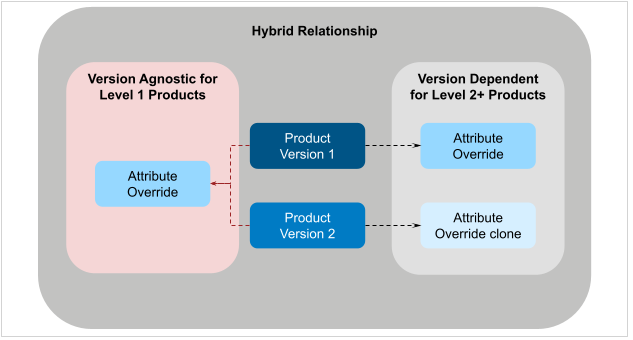
Hybrid —These related records are a mix of version-dependent and agnostic relationships. The Override Definition and Promotion Items are the only entities with a hybrid relationship.
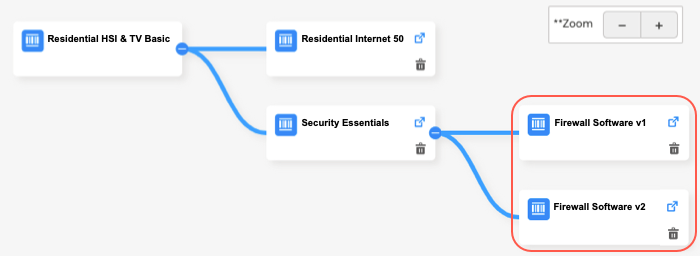
The record is cloned only if the product is the final product in a bundle. As shown in the following example, Firewall Software v1 with a version label of v1 has an override definition record in the context of the Household HSI & TV Basic root product. A new version of Firewall Software has a clone of the corresponding override definition record.
The diagram shows that versions 1 and 2 of a product are related to the same Attribute Override record because the product is a target product.
Related Information:
- Create New Versions of Object Types
- Create New Versions of Products
- Create New Versions of Picklists
- DataPacks and Data Migration with Versioning